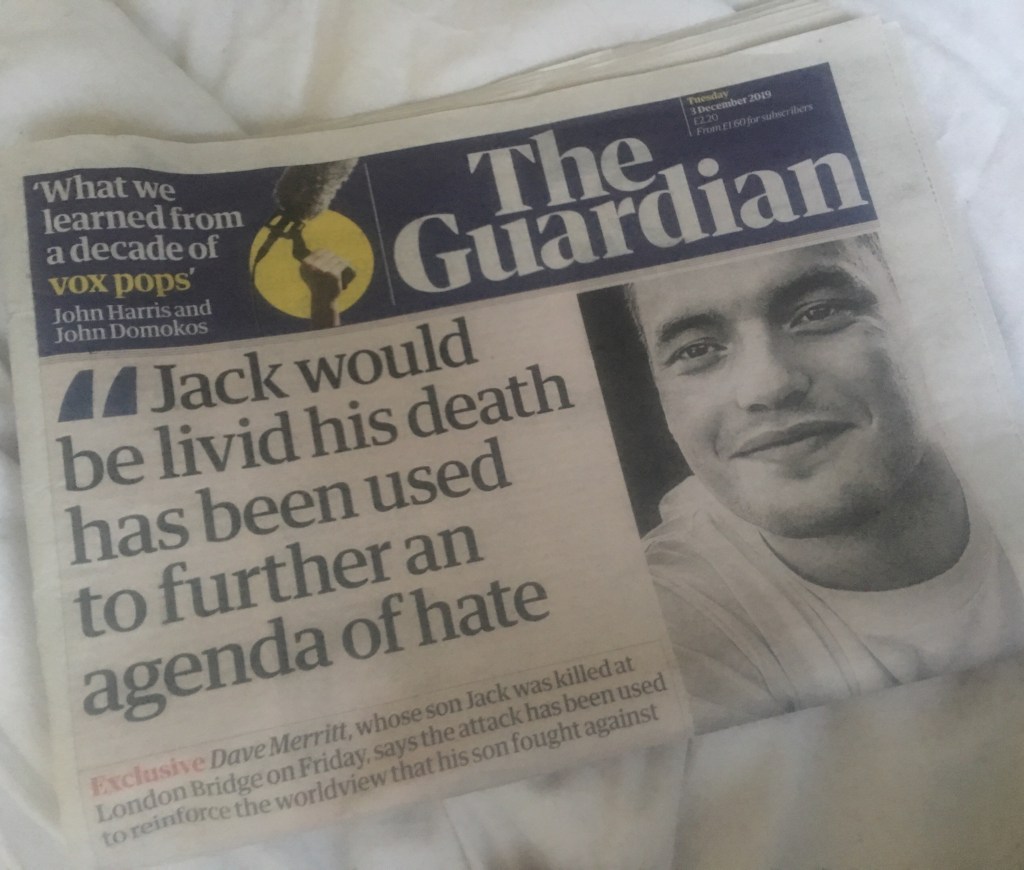
Recently I bought my first newspaper. I was in the middle of buying a few bits for dinner in the middle of rush hour chaos and The Guardian lept out at me. On the cover was a smiley picture of one of the recent London Bridge Attack victims – Jack Merritt alongside the words “Jack would be livid his death has been used to further an agenda of hate” a quote made by his father as part of a short front page article he had written. I’ve never been so compelled to buy a paper and I read it straight away, before I’d even left the shop. It was completely heartbreaking and sobering to read the words of a grief stricken father who saw his son’s death being used to bolster a hateful agenda- something Jack had spent his life fighting against. It followed a statement made by prime minister Boris Johnson which blamed the early release of offender Usman Khan, under a labour government, and called for longer sentencing of prisoners. It’s clear that the timing of this statement, just days before the general election, was a distasteful Tory attempt at political point scoring – one that, particularly with hindsight, highlights the polarisation of our country but also … what the FUCK does he mean by we should be increasing sentences?
Jack Merritt was a course coordinator for ‘Learning Together’ an organisation set up by cambridge University, in order to bring students in Higher Education and Criminal Justice institutions together. As a firm believer in reform and rehabilitation for people incarcerated within a strained and often contradictory system, he was giving a talk in London Bridge when the terrorist attack took place. In the midst of all the chaos and despair, Carl Cattermole, author of ‘Prison A Survival Guide’ ( a book that everyone, including you, should own) went onto BBC News and said something particularly poignant:
“Prison just exacerbates your pre-existing problems. If you’re overly macho it concretes that character trait. If you’re vulnerable you will be victimised. If you’re a drug addict you will find further drugs and if you’re an extremist you will not learn to learn to like the system when you are at the sharp end of the most dysfunctional element”.
– Carl Cattermole, (2019)
And that’s the thing, Usman Khan was a model prisoner and had often asked for support in being de-radicalised. However, with the lack of rehabilitation provided, is it surprising that that he was released and further went on to commit such a heinous crime? I don’t think so. Yes, of course people sometimes fall into old patterns and slip through the cracks – but they should be somewhat ‘anomalies’, not a considerable amount. In 2019 the Ministry of Justice released statistics from 2017 which showed that 48% of adult offenders were reconvicted within a year of their release. This identifies a problem with the system. A problem that can’t just be solved by lengthening sentences, locking people up and throwing away the key – out of sight, out of mind. People need proper rehabilitation and the government must invest in organisations and charities such as Prisoner Reform Trust, Koestler Arts, Pact , Learning Together which really do make a valuable and hopeful impact on people who are rebuilding their lives during and post prison.
One other thing, that is worth mentioning, is that one person involved in trying to disarm Khan was 48 year old John Crilly, a brave onlooker who had known the two victims and was attending the ‘Learning Together’ talk that day as a reformed convict. He was branded as a ‘Hero’ quickly by the same tabloid newspapers who would happily call him scum as a prisoner. There is a problem with the way in which these big media corporations, as a powerful force upon us as a society, contradict themselves. On one hand they say ‘Khan should have never been released from prison’ and on the other they say ‘ the hero was a reformed prisoner’. This juxtaposition, again highlights, the problematic outlook and lack of understanding or more importantly care of those in power.
Watch John Crilly’s interview with BBC News here.
 Everywhere is South of somewhere